


Our Research and Technology
55 min read ● by Ancestra Health Research
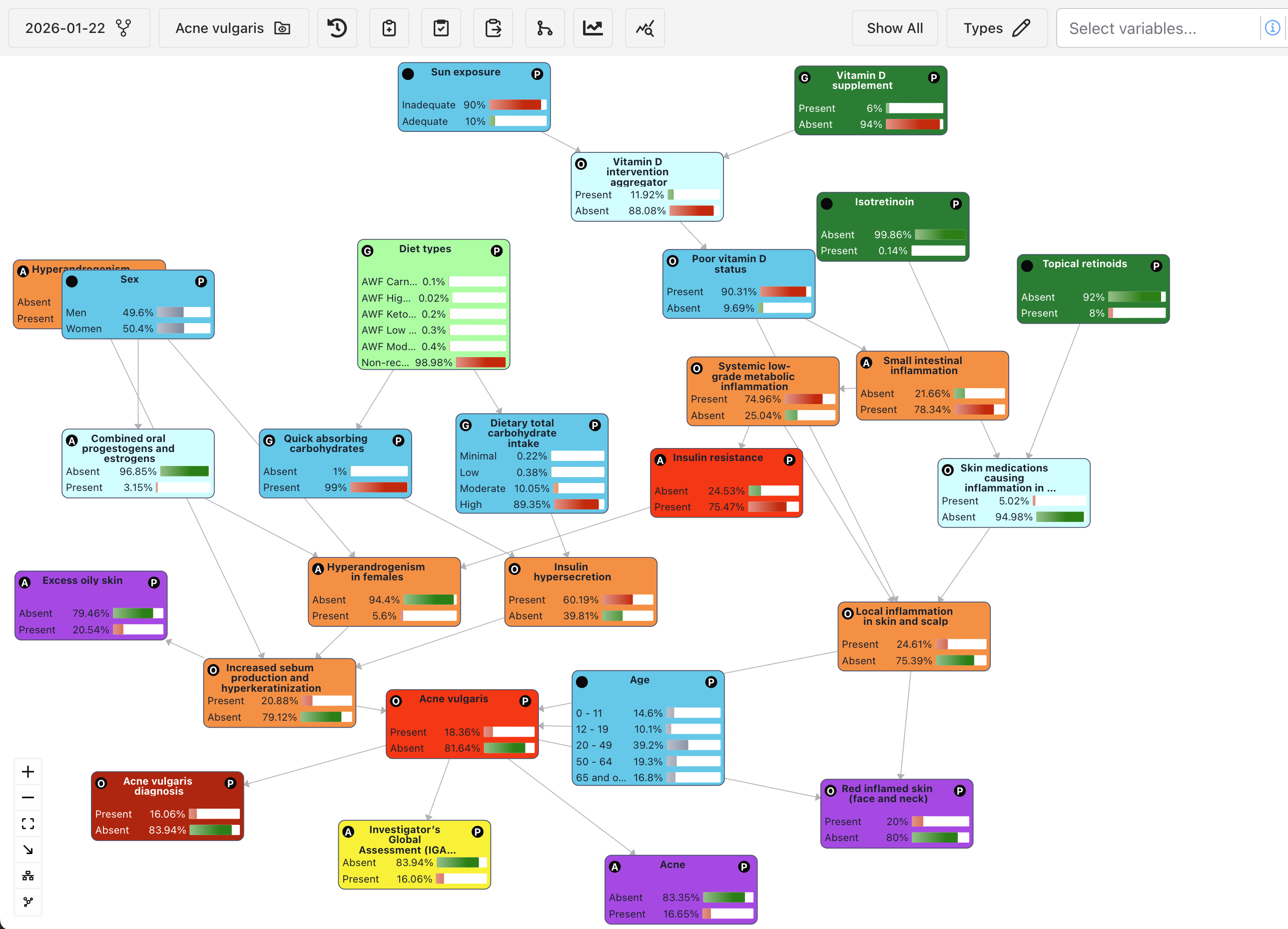
A snapshot of our Bayesian Network in action
Abstract
Many people assume medical and nutrition advice is “settled” and that the majority view is always correct. We don’t. In these fields, popular ideas can stick around even when they’re incomplete, outdated, or shaped by intense financial and social pressures. We also think medicine often focuses too much on managing symptoms instead of asking, “What’s driving the problem underneath?”
That’s why we put a lot of weight on root causes and biological mechanisms—the “how” and “why” behind disease. We also look at health through evolution: humans evolved in environments very different from modern life, so today’s diet, stress, and low activity can clash with our biology. We believe this “mismatch” is a significant reason chronic diseases have become so common.
Because health research can be messy—short studies, hard-to-control lifestyles, biased funding, and overreliance on weak observational data—we treat “evidence” carefully. We compare multiple types of data (human studies, animal studies, and real-world experiences) and seek biologically meaningful patterns, not merely statistically significant ones.
Our approach to improving health prioritizes lifestyle, particularly diet, because it’s the foundation to which humans are adapted. Supplements may help fill gaps (such as vitamin D or magnesium), and medicines can be helpful in some cases, but they shouldn’t replace addressing the basics.
To translate research into practical guidance, the Ancestra Health app uses an in-house built, special type of AI, a Bayesian Network—a structured model that links hundreds of health factors and estimates probabilities (e.g., how strongly a sign may predict a condition). We also use other AI tools to scan and summarize large volumes of scientific information while identifying common biases in the scientific literature.
Biases in medical and nutritional sciences
Most people believe that medical and nutritional sciences are mostly settled and that whatever the majority of researchers say should be followed. Unfortunately, this is not the case in many areas of these fields. Some of the many problems:
● Too much trust in mainstream views
Contrary to common beliefs, no scientific theory should ever be considered the final truth. Most new paradigms that later become mainstream begin as controversial ideas that are supported by only a small minority of scientists.[*] People prefer to turn to “experts”, but, in the case of medical and nutrition science, what if most experts believe in outdated theories and many of their beliefs cause harm to people following their advice?
● Causes and mechanisms are undervalued
Most medical practitioners and even researchers view diseases as collections of symptoms rather than as entities to be understood through their underlying mechanisms and root causes. But most symptoms are part of the healing mechanisms evolved by evolution. Focusing on silencing symptoms means we cannot reverse the disease and may slow or even halt the healing process.[*][*]
● Evolution is not considered
The vast majority of scientists in the field don’t consider evolution when formulating their hypotheses, leading to many theories that don’t make sense in light of it. The exact cause of most chronic diseases is that our diet and lifestyle don’t align with our biology, shaped by evolution. As a result of a flawed mindset, holistic lifestyle interventions that could restore people’s homeostasis by eliminating the root causes of disease are often dismissed as unscientific by the mainstream.[*][*][*]
● Carbohydrate addiction
Almost all humans in modern societies are addicted to quick-absorbing carbohydrates to some extent.[*] Being attracted to foods high in carbohydrates and low in fiber didn’t cause problems when such foods weren't available. The problem began with the advent of agriculture and has worsened at an accelerating rate since then. Agriculture, coupled with the food industry, produces increasingly addictive, lower-quality foods. It is hard to convince a person with an addiction that the substance they are addicted to is dangerous and that they should stop taking it. The same is true for scientists, doctors, and decision-makers about dietary policies. It is unsurprising that official nutritional advice advocates low-quality foods that are high in rapidly absorbing carbohydrates.[*][*][*]
● Natural therapies are not patentable
To achieve high profits from a new pharmaceutical, it must be protected by patents. However, compounds and materials that occur in nature cannot be patented; therefore, most pharmaceuticals are xenobiotics, foreign to our biology. Side effects of xenobiotics, even serious ones, can arise years or decades after exposure, making it difficult to determine their cause.[*][*]
● Sponsors decide what science accepts
Sponsors have a significant impact on what mainstream science accepts or rejects. When large corporations in the pharmaceutical and food industries develop products that support fashionable hypotheses (such as that grains are healthier than meat or that saturated fat is harmful and seed oils are beneficial), they will invest in ensuring that those hypotheses are not challenged. This will keep harmful ideas mainstream for a very long time. [*][*][*][*]
● Suppression of on-conforming views
Those who don’t support mainstream views can easily become pariahs. They have fewer opportunities to share their ideas. Journals don’t accept their publications; their posts get lower rankings on social networks, and they risk their careers.[*][*][*]
● Hard evidence is hard to achieve
It is hard to provide strong evidence in this field because even randomized controlled trials (RCTs), considered high-level evidence, have many shortcomings. A list of just a few issues that occur frequently:
1. Many studies cannot be conducted in humans, only in animals, due to ethical concerns (e.g., perceived or actual risks of the intervention or no-intervention). For example, participants in control groups of drug trials are often also administered a drug instead of a true placebo to “protect” them.
2. The product must be very profitable to cover the costs of the clinical trials, which are very expensive.
3. Funders often ensure their products receive a positive evaluation.
4. RCTs are too short to demonstrate many of the intervention's harmful or beneficial effects.
5. In lifestyle interventions, it is difficult to change a single variable; many confounders are not controlled for.Tricks are used to claim statistical significance for an effect that is clinically not significant, while adverse effects remain hidden.
6. In lifestyle interventions, it is difficult to change a single variable; many confounders are not controlled for.Tricks are used to claim statistical significance for an effect that is clinically not significant, while adverse effects remain hidden.
7. You cannot randomly assign people to different lifestyles or diets over the long term.
● Low-quality observational studies get too much credit
Papers in medical science often rely on observational studies with low correlations to establish causality. Important confounders and results from other fields may not be considered in those studies. (Examples are papers stating that meat causes cancer or heart disease.[*])
How do we ensure cutting-edge science, avoiding the typical biases
● Medical Research team
Our Medical Research team builds the knowledge base for the Ancestra Health app. The team comprises scientists with backgrounds in molecular biology and medical science. All members have a deep understanding of the biological mechanisms underlying healthy and pathological states, as well as their interactions. They think holistically because symptoms and diseases are often manifestations of underlying pathologies that share common causes.
● Critical thinking
Because the medical literature is generally low in quality and biased, our team members must be strong critical thinkers. Being able to synthesize knowledge from a vast number of biased, variable-quality papers is vital. We use LLMs trained to mitigate common biases to systematically search the scientific literature and identify and summarize the most relevant papers on the subject.
● Assessing the strength of evidence
"All models are wrong, but some are helpful."[*] This phrase is especially useful in biology, where the deeper you go into the details and the broader context you choose, the more anomalies you find. We should be aware that all models provide acceptable approximations only within a given context. When we compare theories or develop our own, we collect papers on the subject and assess the evidence they provide. Often, even clinical trials (outcome studies) don’t prove convincing because of the biases we find in them. Animal studies are necessary because they typically provide greater mechanistic detail than human studies. However, the animals used in the study may respond differently from humans. Observational (epidemiologic) studies alone provide less evidence than well-designed clinical trials. Still, if there are no obvious biases in the studies and the effect size is large, they can support the case.[*] Anecdotal evidence shouldn’t be neglected either. If a large number of people’s stories overlap significantly, we should not dismiss them. Our research team considers and synthesizes evidence from multiple sources and, when necessary, develops new mechanistic models based on it.
● Cutting-edge science
When we expand our knowledge base to include a new disease, the research team reviews relevant papers, including recent and older scientific literature. Our team is up to date on the latest scientific findings and theories. Knowledge sharing is a key component of their workflow.
Our core assumptions
● Address the root causes instead of the symptoms
The best way to treat disease is not to focus on alleviating its symptoms but on identifying and targeting its root causes. If the underlying causes persist, the disease will worsen over time, and additional diseases may develop, even if some symptoms are mitigated. Obesity is merely an early manifestation of a poor lifestyle. Over a more extended period, other diseases can follow, such as insulin resistance, fatty liver disease, diabetes, atherosclerosis, cancer, etc. We must recognize the problems early and address the root causes to reverse them.
● Evolution in the core
As Theodosius Dobzhansky[*] put it, “Nothing in biology makes sense except in the light of evolution". Humans, just like all species, are the product of evolution. Findings from fields such as archaeology and archaeogenetics must inform medical science. Most noncommunicable chronic diseases have arisen because our biology is adapted to environments very different from our modern society. How our biology responds to external factors must be explained using key concepts such as mutation, genetic drift, and natural selection. We evaluate our ideas and those from the literature by assessing their alignment with evolutionary logic. For example, substantial evidence on our ancestors' diets and lifestyles helps us understand why most modern diets and low physical activity contribute to disease.
Our theory also considers human and animal studies when available.
● The evolutionary mismatch is to blame for the diseases of civilization
We believe that the rapid rise in non-communicable chronic diseases stems from a mismatch between our Stone Age biology and the modern world, which is changing at an ever-increasing pace. Inappropriate modern diets and low physical activity play significant roles in these processes.
Biology is highly complex because evolution has always provided ad hoc workarounds for changing environments, rather than well-designed solutions to address future challenges. We are not well-adapted to our modern environments. It is wiser to follow many aspects of the lifestyles our ancestors maintained for about two million years than to risk the diseases of our civilization, even if change requires initial effort. It is important to note that evolutionary biology is just one of the foundations of Ancestra Health.[*]
● The overlapping mechanism among most of the chronic diseases
Dysbiosis, driven by diet and lifestyle, on barrier surfaces, especially the digestive tract, triggers a cascade of immune stress. Harmful pathogens overgrow and release PAMPs (pathogen-associated molecular patterns). Stress and injuries cause the cells to release DAMPs (Damage-associated molecular patterns). PAMPs and DAMPs reach organs via the lymphatic system and the bloodstream. The immune system will interpret the presence of these particles as a constant pathogen attack, triggering immune responses and local and systemic inflammation. The immune attack will increase reactive oxygen species (ROS). The immune attack will cause direct harm to our organs.
Because the immune system's capacity is limited, it reduces our ability to defend against real infections, leading to greater disease. This cascade of events leads to a range of chronic diseases, depending on our personal vulnerabilities.[*]
● Lifestyle over supplements and drugs
The most significant contributor to long-term health improvements is usually lifestyle, especially our diet. Our ancestors didn’t need to take supplements or drugs to avoid chronic diseases. Supplements can provide nutrients that are hard to maintain at healthy levels in our modern lives, like magnesium and vitamin D. However, supplements, especially drugs, are usually overhyped and taken as an alternative to healthier lifestyles, which will never work well enough, and they often have harmful side effects. Whenever possible, we should obtain our nutrients from the type of foods to which we are adapted. An organic, nose-to-tail, animal-based diet can provide all the nutrients healthy people need; however, supplements and, in some cases, medications may be helpful for certain diseases.
Our technology
● Bayesian Network
The knowledge base of the Ancestra Health app is a Bayesian Network[*], a probabilistic graphical model that represents many hundreds of variables, their causal relationships via a directed acyclic graph, and their conditional dependencies expressed as probabilities. Our Bayesian network is trained on thousands of so-called requirements, extracted from or inferred from tens of thousands of scientific papers. The requirements used for training have this structure: the conditional probability of a state of A variable, given the observation of a state of B variable, is X%:
P(A = a | B = b) = X%
For example, the probability of insulin resistance given skin tags is 96%:
P(insulin resistance = present | skin tags = present) = 96%
● Extraction of information using LLMs
We use Large Language Models (LLMs) to retrieve information from scientific papers and other online sources. The LLMs are trained to detect common biases in these sources, increasing the effectiveness of our researchers.
● Apply for Early Access Membership
Our Exclusive Program for Free
Ancestra Health is inviting individuals with chronic health conditions to participate in our value-packed Early Access Membership program at no cost.
This special Early Access Membership includes the following free benefits for our 6-month program:
✓ app subscription
✓ weekly supervision
✓ lab tests
● BLOG POST
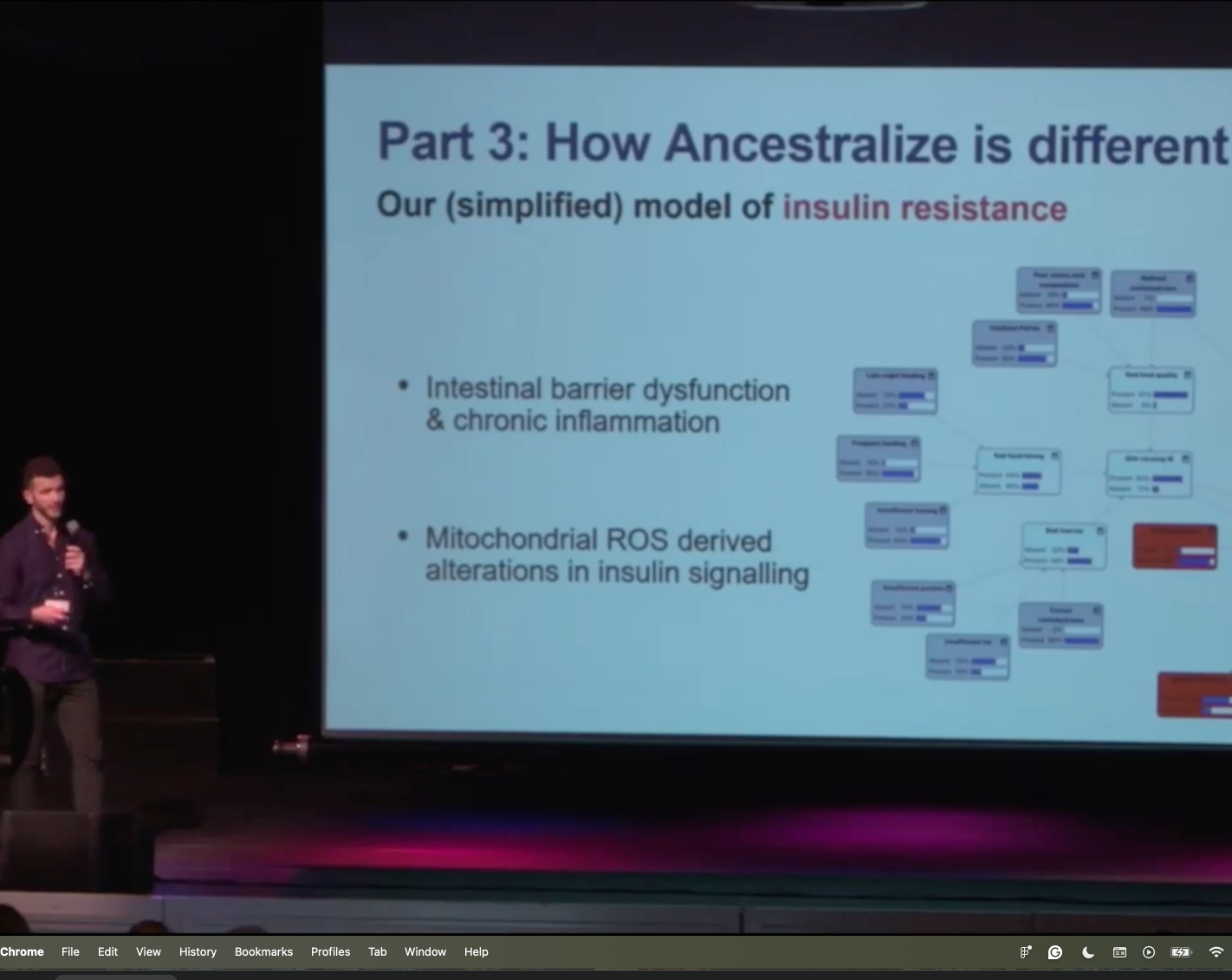
The video recording of our colleague Raphael Sirtoli’s presentation at the CoSci Conference 2024, about our pre-launch app
We regularly publish science-backed health articles in our blog. If you don’t want to miss any, please subscribe to our newsletter.
A snapshot of our Bayesian Network in action